
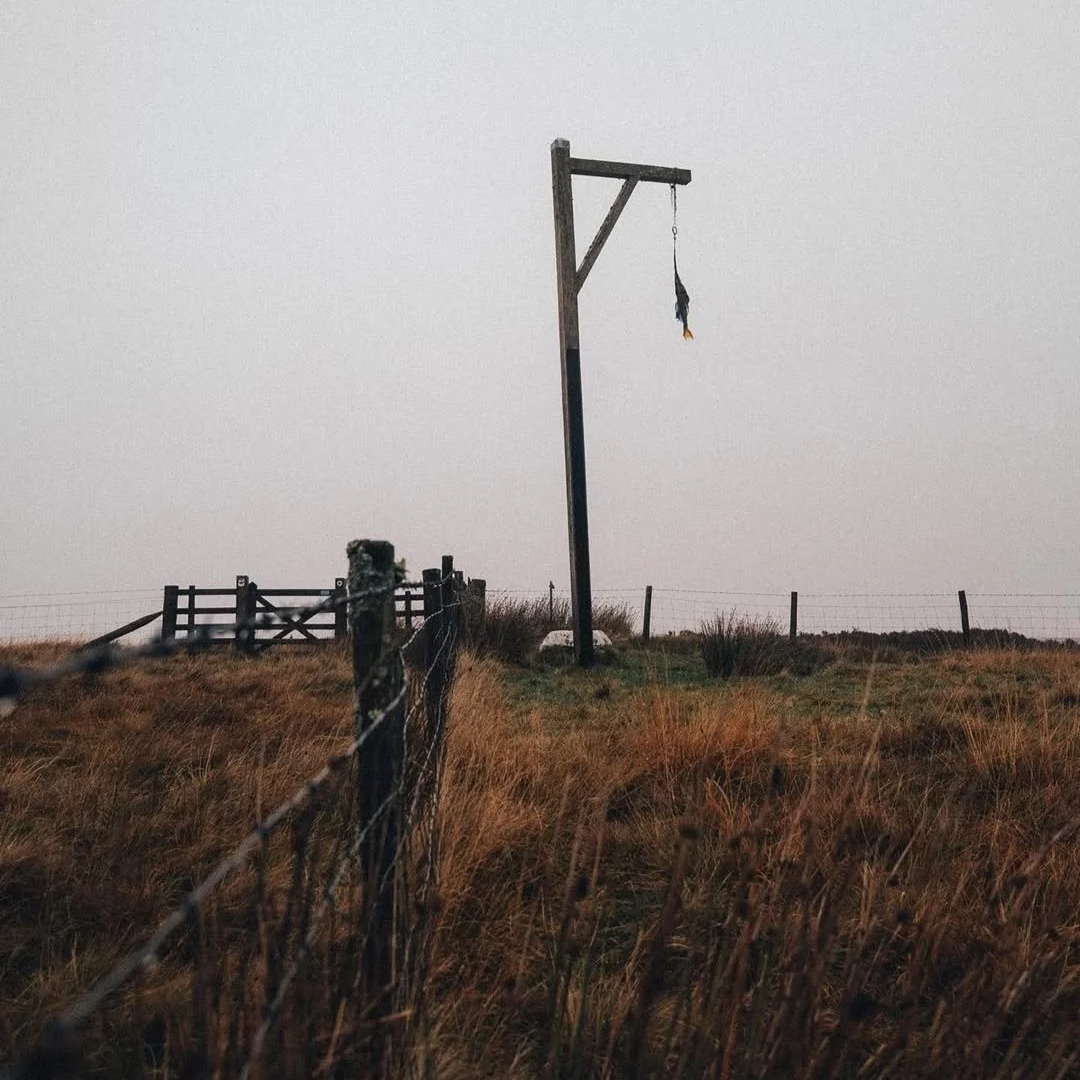
The road south-east from Elsdon climbs onto open moor. There are no houses, no hedges and very few trees. Then, on the skyline, a tall wooden post with a single arm. From it, on a short length of rope, hangs a head. This is Winter's Gibbet. It marks the end of one of the most notorious crimes in Northumberland's history, and more than two centuries later it still stops drivers in their tracks.
The murder at Raw Pele
Margaret Crozier was an elderly woman who lived alone at Raw Pele, a small hamlet near Elsdon. She ran a shop from her home, selling drapery and other goods to locals and to travellers on the nearby drove road. On the evening of Monday 29 August 1791, two friends, Elizabeth Jackson and Mary Temple, came to spend the evening with her. As they got ready to leave, a dog began barking furiously at a pile of hay close to the house. Uneasy, the women reminded Margaret to bolt her door.
Early the next morning, a customer named Barbara Drummond arrived to find thread and small items from the shop scattered outside the door. She raised the alarm. Elizabeth Jackson and her husband, William Dodds, hurried to the house and opened the door. Margaret lay dead on her bed. Her throat had been cut and bound tightly with a handkerchief. Beside her lay a long, bloodstained gully knife, the kind a butcher would use. A deep wound across one palm showed she had fought for her life. Clothing, cloth and linen had been taken from the shop.
The boy who noticed the nails
A killing this brutal, in a community this small, horrified the whole district. A reward was offered and people of every class joined the search.
Two young boys came forward. The day before the murder they had watched a man and two women resting and eating at a sheepfold on Whisker-Shield Common, overlooking Raw. The man was six feet tall and powerfully built, with long black hair tied back. He wore a light coat, blue breeches and grey stockings. Both women were tall, in grey cloaks and black bonnets. One of the boys, Richard Hindmarsh, had paid close attention. He saw the man cut up food for the group with a large gully knife. He had also studied the man's shoes as he ate, noting the type and number of nails in the soles.
At the inquest, Hindmarsh was shown the knife from Margaret's bedside and identified it as the same one. The footprints outside her house matched the nails he described. More sightings followed. The three had been seen with a loaded mule near Harlow Hill. Constables arrested William Winter near Horsley, and later caught two sisters, Jane and Eleanor Clark, at Ovingham and Barley Moor. Winter's shirt was stained with blood. He claimed it came from a fight, but few believed him. On 3 September 1791 all three were committed to Morpeth Gaol.
Sixteen hours at the Moot Hall
The assizes sat only once a year, so the three waited in gaol for almost twelve months. The trial finally opened at the Moot Hall in Newcastle in August 1792 and lasted sixteen hours. The boys gave their evidence on the knife and the footprints. A close friend of Margaret's identified a nightcap found on one of the sisters. She had made it for Margaret herself.
All three were found guilty and sentenced to death. The judge ordered that the sisters' bodies be handed to surgeons for dissection. Winter's body was to be hung in chains on a gibbet within sight of the murder, a punishment that echoed the old reiver days, when corpses were left on display as a warning. On the morning of Friday 10 August 1792, William Winter and Jane and Eleanor Clark were hanged at Westgate in Newcastle. Winter confessed before he died. The sisters protested their innocence to the end.
Hung in chains at Steng Cross
After the hanging, Winter's body was cut down and carried by cart back to the moors. At Steng Cross, the highest point of the old drove road, it was hoisted onto a purpose-built gibbet. Thousands gathered to watch. It was left there until his clothes rotted away. At first the smell was so bad that horses refused to pass. Once the flesh had gone, his loose bones were gathered into a sack, tarred on the inside against the weather, and hung up again. In time the sack decayed too, and local shepherds buried what fell.
The head that keeps coming back
When nothing of Winter remained, a wooden figure of a man was hung in his place. It did not last. Neither did the gibbet. Locals believed a splinter of its wood would cure toothache, and the post was slowly whittled away.
In 1867 Sir Walter Trevelyan of Wallington, who owned the land, put up a replica complete with a wooden effigy of Winter. Over the years the body was used for target practice and stolen, until only the head was left. That head has been stolen and replaced many times since, in wood, stone and fibreglass. The gibbet itself has been vandalised, blown down and rebuilt more than once. Each time, it goes back up. The structure that stands today is Grade II listed.
Some say Winter has never left. Stories tell of a figure seen near the cattle grid down the road, and of fog that rolls in from nowhere. Stand there on a grey afternoon, with the head turning slowly in the wind, and it is not hard to see why the tales persist.
Visiting Winter's Gibbet
The gibbet stands beside the B6342, about two miles south-east of Elsdon, roughly midway between Elsdon and Harwood at the edge of the forest. There is no sign, so watch the skyline as the road climbs onto the moor.
At its foot sits a squared block of sandstone. This is the base of Steng Cross, the medieval wayside cross that once marked the highest point of the drove road, used by Scottish drovers taking cattle south to English markets. The cross itself is long gone, but the base gave the spot its name.